
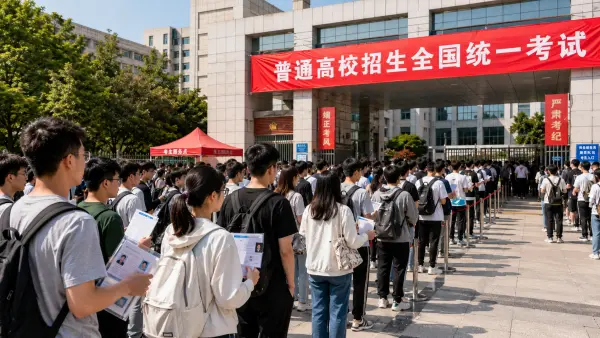
On November 30, 2025, 2.83 million people sat China’s national civil service exam at the same time, in 250 cities, competing for 38,100 government positions. One of those positions, an entry-level police officer role at an immigration repatriation center in Ruili, a small city on the Myanmar border, drew 6,470 applications for a single opening.
That number is not a fluke. It’s the sharp end of a labor market trend that has been building for years, and it says more about what happens when a country over-produces credentials than any unemployment rate does.
The math behind the panic
China’s civil service exam has gotten harder to get into every year, and not by a little. The ratio of qualified applicants to available posts ran roughly 70 to 1 in 2023, climbed to 86 to 1 in 2025, and hit a record 98 to 1 this year, according to state-run China News Service figures reported by Caixin Global. Measured against the 2.83 million who actually showed up to test, the ratio comes out closer to 74 to 1, a smaller but still brutal number.
The 2026 hiring plan was actually smaller than 2025’s, down by about 1,600 positions. Over the same stretch, the applicant pool grew by roughly 300,000 people. The job openings and the job seekers are moving in opposite directions, and there is no version of next year’s exam where that gap closes on its own.
Why a government clerkship on the Myanmar border became the most competitive job on Earth
The Ruili position is not glamorous. It’s entry-level, it’s remote, and most people in China couldn’t find the city on a map. That’s exactly what makes the 6,470-to-1 ratio worth paying attention to: competition for state-sector stability has gotten intense even at the system’s least prestigious edges, not just at its most visible ones. When a low-profile clerkship pulls thousands of applications, that’s a sign the shortage of “safe” jobs has gotten deep, not just narrow at the top.
The supply side of this problem is enormous
China’s gross higher education enrollment rate hit 60.2 percent in 2023, according to the country’s Ministry of Education, up from a rate widely cited at under 4 percent in the late 1980s. Total higher ed enrollment went from 3.9 million students in 1990 to 61 million in 2024, per UNESCO’s Global Education Monitoring Report.
That expansion did what it was designed to do. China graduated a record 12.22 million college students in 2025 and awarded more than 97,000 PhDs in 2024, nearly double the number from a decade earlier. In Beijing specifically, postgraduate degree recipients outnumbered undergraduate degree recipients for the first time in 2023, according to the South China Morning Post, and a similar pattern has since shown up at more than 50 leading Chinese universities.
What it didn’t do is generate a matching number of jobs that a degree was supposed to lead to. The civil service exam has become one of the clearest places to watch that gap play out, because it’s a fixed, countable number of openings against an uncapped, growing applicant pool.
The most credentialed delivery rider in China
Ding Yuanzhao scored nearly 700 out of 750 on China’s 2004 college entrance exam, good enough for Tsinghua University. He followed that with a master’s in energy engineering from Peking University, a PhD in biology from Nanyang Technological University in Singapore, a master’s in biodiversity from Oxford, and a postdoc at the National University of Singapore. By mid-2025, at 39, he was delivering food orders on a scooter in Beijing.
His story broke first in Chinese domestic media, not in Western coverage looking to score a point about China’s economy, which is itself worth noting. After the 2025 exam results came out, Ding posted a video telling students who’d scored badly not to despair, since a lot of high scorers end up in similar jobs anyway.
Ding has said publicly that the choice was partly deliberate: stable income and flexible hours while he looks for something that matches his qualifications, not a purely involuntary outcome. One person’s career path doesn’t prove a systemic pattern by itself. But the reason his story spread inside China, discussed alongside the same exam and enrollment numbers above, is that it landed as a recognizable data point rather than an outlier.
What this means if you’re job hunting anywhere, not just China
The specific numbers here are Chinese, but the underlying mechanism isn’t unique to China. Any labor market where credential production scales faster than the number of jobs those credentials were meant to unlock ends up with the same result: more qualified people chasing the same fixed pool of stable positions, and status competition creeping down into jobs that used to be uncontested. South Korea and parts of Southern Europe have versions of this same story with their own numbers attached. China’s is just the most extreme current example, because it ran the experiment at a scale and speed no other country has matched.