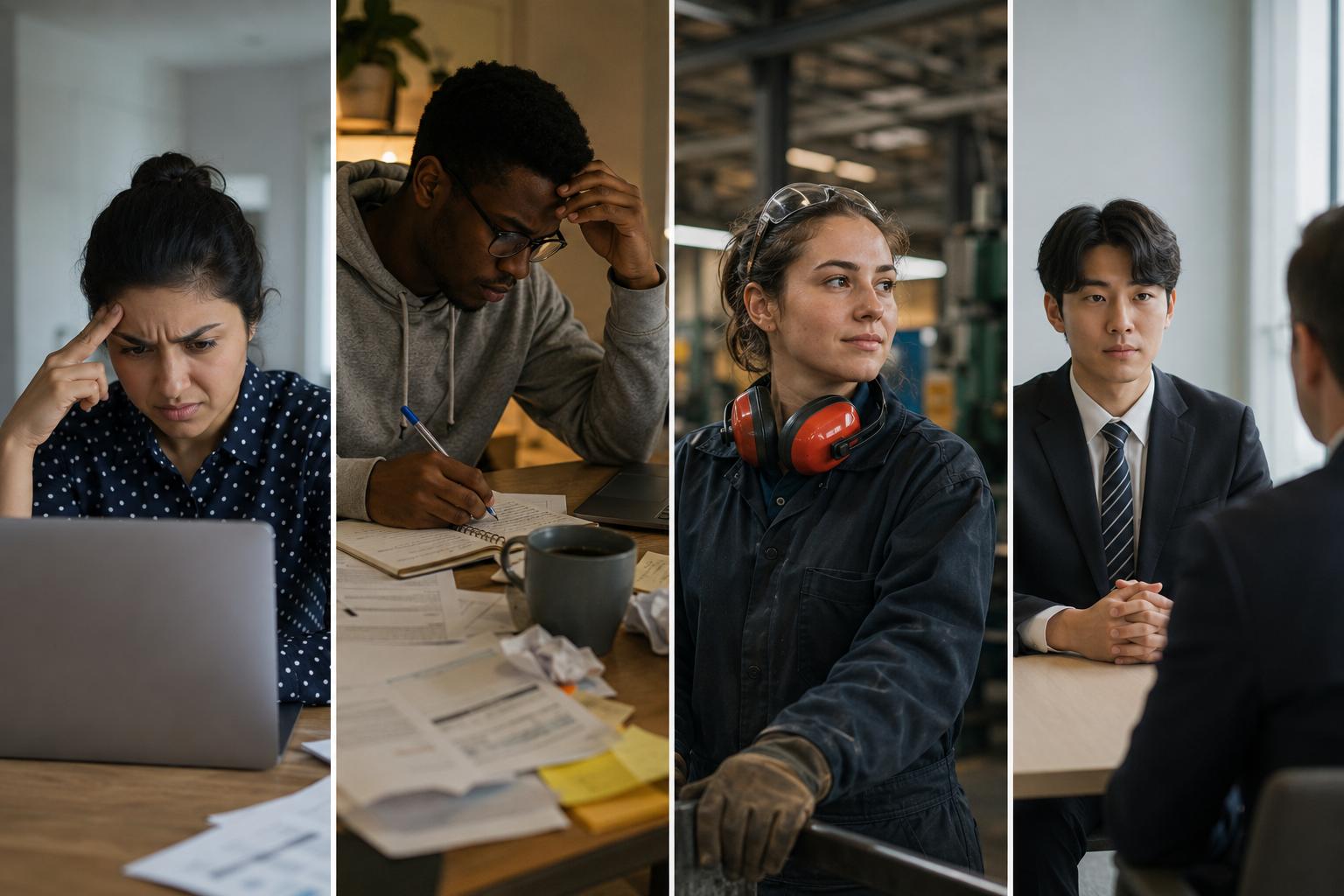
If the job market had a mood right now, it would be “waiting room.” Not desperate, not thriving — just suspended. Hiring is slow, layoffs are low, and the gap between those two facts is where millions of job seekers currently live. Here’s what’s actually happening, and why some of it is stranger than the headlines suggest.
You might be applying to jobs that don’t exist
Ghost jobs — postings for roles companies have no real intention of filling — have gone from an open secret to a documented epidemic. A 2026 Clarify Capital study found roughly one in seven active job postings are ghosts. In some sectors the rate is considerably higher: among senior-level postings, approximately one in five is fake.
Why do companies do this? The reasons range from the mundane (forgetting to take down a filled role) to the calculated (81% of recruiters surveyed by MyPerfectResume admitted their employer posts jobs to maintain a presence on job boards even when not actively hiring). Some post phantom listings to gauge what talent is available. Others do it to make existing employees feel replaceable.
The practical upshot for job seekers: if a posting is more than 30 days old, appears only on aggregators and not on the company’s own careers page, and omits salary information, treat it with skepticism before investing significant time.
Ontario, Canada has begun requiring employers to disclose whether a posting reflects an actual vacancy. Regulators in the U.S. are watching the issue. The practice is not going away quietly.
AI is making the hiring process worse for everyone, including employers
Here is the loop no one designed but everyone is stuck in. AI tools have made it nearly free and fast to tailor a resume to any job posting. Nearly half of job seekers now use AI in their applications, and close to 80% plan to submit more applications than they did last year. The result: application volumes have roughly doubled since 2022, according to recruitment data cited by HiringThing.
Recruiters, overwhelmed, rely more heavily on automated screening tools to filter the flood. Those tools increasingly can’t tell the difference between a genuinely strong candidate and someone who used AI to generate a polished but hollow application. As one recruiter put it to Fortune: “Strong candidates are getting rejected because their human-written resume does not look as polished as an AI-generated one.”
Meanwhile, 60% of job seekers surveyed by Monster in 2026 said they cannot tell whether a human ever read their resume. More than half said their biggest frustration is never hearing back after applying at all.
The irony is that the tools meant to make hiring more efficient have made it feel less human on both sides of the table.
One genuinely good shift: degrees matter less
Not everything in the current market is grim. One of the more meaningful changes underway is the continued move toward skills-based hiring — evaluating candidates on what they can actually do rather than which institution they attended.
Multiple large employers have quietly dropped degree requirements for roles that never genuinely needed them. Micro-credentials, certifications, and demonstrable project work are gaining credibility as alternatives to four-year degrees. This shift matters globally: in many countries, the cost and access barriers to university education have historically locked capable people out of roles they were entirely qualified to perform.
For career changers and people who learned through experience rather than formal education, this is a real opening — not a marketing phrase.
The frozen market is hardest on people trying to get in
The phrase circulating among labor economists right now is “low hire, low fire.” Layoffs remain relatively low. But hiring has slowed significantly, with job openings outpacing actual hires by more than two million per month in the U.S., according to Bureau of Labor Statistics data. The National Association of Colleges and Employers predicted 2026 would be the worst job market for new graduates since the start of the pandemic.
The people most exposed to a frozen market are those trying to enter it for the first time. Workers already in roles have some protection — employers are holding onto existing staff even while they pause on adding new ones. But for new graduates, career changers, and anyone trying to break into a new field, the landscape is genuinely thin.
The sectors holding up best — healthcare, skilled trades, logistics — tend to be ones with physical, hands-on components that can’t be easily automated or outsourced. That pattern is not coincidental, and it’s not temporary.
Further Reading
- Resume Genius 2026 Job Seeker Insights Report: https://resumegenius.com/blog/job-hunting/job-seeker-insights-report-2026
- Indeed 2026 Jobs & Hiring Trends Report: https://www.hiringlab.org/2025/11/20/indeed-2026-us-jobs-hiring-trends-report/
- Fortune — Employer ghosting hits three-year high: https://fortune.com/2026/03/20/job-seekers-arent-imagining-things-candidates-ghosted-by-employers-hit-three-year-high/
- HiringThing — The Hiring Market in May 2026: https://blog.hiringthing.com/the-hiring-market-in-may-2026-stuck-in-neutral
- MintCareer — Ghost Jobs Guide 2026: https://mintcareer.ai/ghost-jobs-guide