The conversation about AI and employment tends to split into two camps: the catastrophists and the optimists. Neither is particularly useful if you’re trying to figure out what’s actually happening to the job market right now. Here are five developments worth paying attention to.
1. The entry-level hiring slowdown is real — and it predates the layoffs
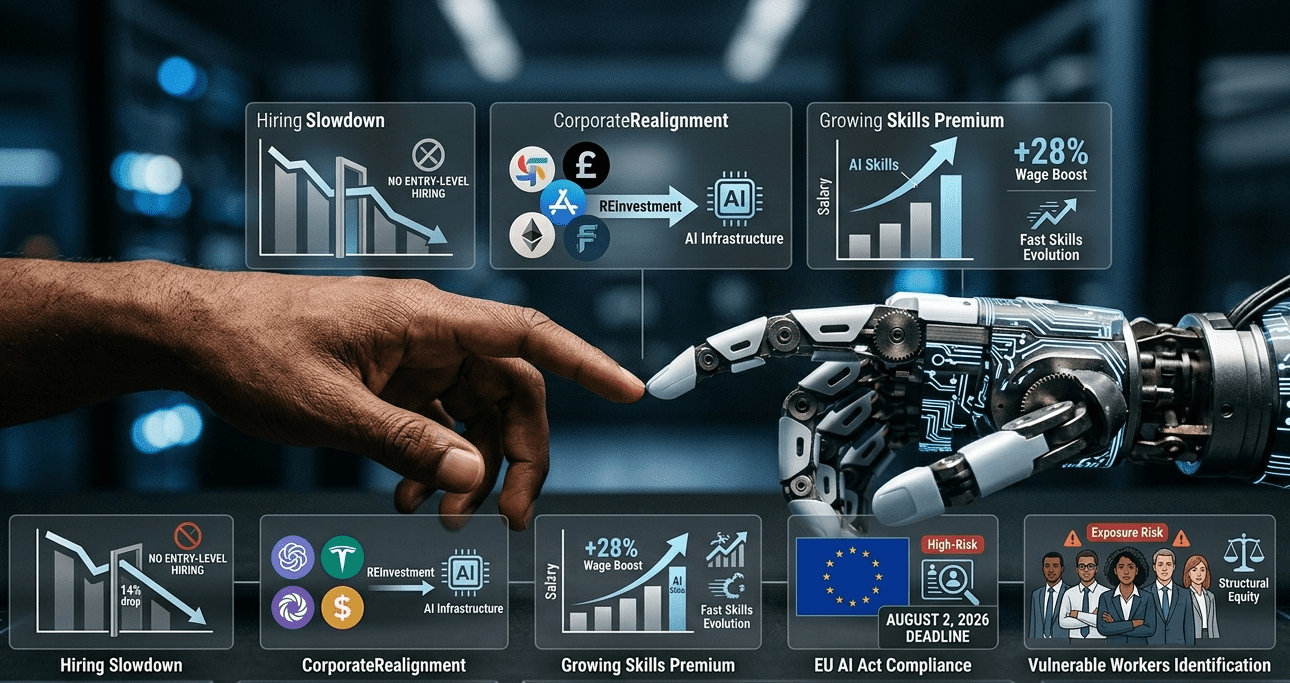
The most concrete near-term effect of AI on employment isn’t mass redundancy. It’s something quieter: a 14% drop in the job-finding rate for AI-exposed occupations since the rise of generative AI, compared to 2022. Companies aren’t firing entry-level workers in large numbers — they’re simply not replacing them when they leave, and not hiring as many to begin with.
Stanford data cited by the GSD Council shows a 13% decline in entry-level hiring for AI-exposed roles since the rise of generative AI. For new graduates entering fields like software development, content, customer support, and data processing, this is already the reality. The jobs haven’t disappeared — the pipeline into them has narrowed.
2. Major companies are cutting headcount and calling it strategy
This year’s corporate layoffs have a different character from previous cycles. Companies are not cutting because they’re losing money — many are reporting record profits. They are deliberately reducing traditional headcount to redirect investment into AI infrastructure.
Oracle eliminated 30,000 roles globally, Amazon cut more than 16,000 corporate positions, and Meta initiated a fresh round affecting 8,000 employees, all framed as AI-driven realignment. Goldman Sachs Research estimates AI is already reducing U.S. employment by roughly 16,000 jobs per month. In total, the tech sector alone has eliminated over 113,000 jobs across nearly 180 corporate events so far in 2026.
Worth noting: some researchers call this “AI washing” — companies using AI as cover for cuts driven by financial pressures rather than genuine automation. A March 2026 Built In analysis found that most companies still lack AI systems capable of replacing workers at scale, and that the official narrative often overstates the technology’s role. The honest answer is probably somewhere in the middle.
3. The skills premium is growing — fast
If there’s a clear winner in the current shift, it’s workers who can use AI tools effectively in professional contexts. Fifty percent of U.S. tech job postings now require AI skills, and professionals with those skills earn 28% more on average. Skills in AI-exposed roles are evolving 66% faster than in other jobs.
The IMF’s January 2026 Staff Discussion Note on new job creation in the AI age found that about one in ten job vacancies in advanced economies now demands at least one new AI-related skill, with the incidence roughly half that in emerging market economies. Importantly, these skills boost wages and employment on average — but they also deepen polarization, primarily benefitting high-skilled workers and, indirectly, lower-skilled workers in service sectors. Middle-skill workers bear the most risk.
4. Europe is moving to regulate AI in hiring — and the deadline is close
While the employment effects of AI play out unevenly across markets, the European Union has taken a concrete regulatory position. Under the EU AI Act, any AI system used for recruitment or HR decision-making is classified as “high-risk,” subject to requirements for human oversight, bias monitoring, documentation, and transparency with candidates.
The key deadline for full compliance is August 2, 2026 — less than three months away. The Act applies not only to EU-based companies but to any employer using AI to screen candidates for EU-based roles, regardless of where the company is headquartered. For job seekers in Europe, this means employers will soon be legally required to inform candidates when AI played a role in hiring decisions, and to be able to explain how. Whether enforcement keeps pace with the deadline is a separate question.
5. The most vulnerable workers are not who most people assume
Discussions about AI job risk tend to focus on blue-collar and manual work. The data points elsewhere. White-collar workers in financial services and media now express higher concern about automation (67%) than workers in transportation (60%) or retail (59%). Content writers, HR screening staff, customer support agents, and junior software developers face higher near-term exposure than most trade workers.
Gender is also a factor. Globally, 4.7% of female jobs fall into the highest-risk category for AI displacement, compared to 2.4% for males, partly because women are more concentrated in administrative, clerical, and customer-facing roles. This isn’t a minor statistical footnote — it’s a structural equity issue that policymakers in most markets have barely begun to address.
The picture that emerges from the data is not a sudden cliff edge — it’s a slow squeeze, uneven across sectors, geographies, and career stages. The workers most at risk are often the ones with the least visibility in the debate.
Statistics in this post are linked to primary sources at time of publication. If you find a broken link, let us know.