
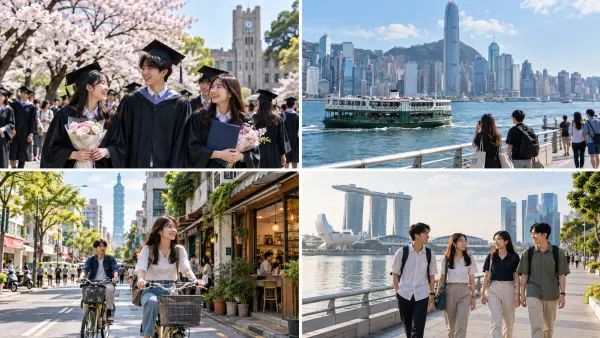
Five Asian jurisdictions run a formal route that lets a recent graduate stay on to look for work: South Korea, Japan, Taiwan, Hong Kong and Singapore. They differ on three points that matter more than the headline length of stay: whether the graduate may work during the search, whether the degree has to come from a local university, and what the applicant must prove. Hong Kong grants an initial 24 months to international graduates of Hong Kong universities who apply on time, Taiwan lets graduates take any job during the stay, and Singapore allows the stay but bars work.
Korea’s D-10 can run to three years in total for graduates of Korean universities, while Japan’s route gives one year, with a second available only through local-government programs. Graduates of universities abroad get narrower openings: Japan’s J-Find, Hong Kong’s Top Talent Pass, relaxed rules in Korea for top-200 graduates, and a Taiwanese work permit for the same group. Singapore had no comparable route for foreign graduates in the sources checked. Status is as of 5 October 2026, and the five jurisdictions are the ones where an official route turned up; other Asian countries were not assessed.
Korea’s D-10: up to three years, with a language test deciding who skips the points test
South Korea’s D-10-1 status is the job-seeker route for graduates of Korean universities. Since 29 October 2025 the Ministry of Justice grants it in one-year blocks up to a maximum of three years, where it previously granted six months at a time up to two years, according to the ministry’s October 2025 release. The same release lifted the cap on total internship time during the search and extended the limit at a single company from six months to one year.
Conditions for a first conversion from the D-2 student visa are set out in the Immigration Service’s Visa Navigator guide, in the December 2022 edition checked here. It waives the points test for graduates who earned an associate degree or higher in Korea within the past three years and hold TOPIK level 4 or an equivalent Social Integration Program result. Part-time work during the search is limited to that same group, and anyone who has previously held a professional work status such as E-7 is excluded.
Japan: one year of searching, with a second only through local programs
Japan’s route for graduates of Japanese universities is a Designated Activities status, which the Immigration Services Agency grants for six months and allows to be renewed once, giving one year of searching after graduation. The graduating institution has to recommend the applicant, and the applicant has to show that the search is continuing. A second year is available only when a local government runs a qualifying job-support program and certifies the graduate as a participant.
Part-time work is possible with permission, up to 28 hours a week. Internships that form part of the search can be approved for longer hours.
Hong Kong and Taiwan: open work rights during the search
Hong Kong’s Immigration Arrangements for Non-local Graduates cover non-local students who earned a full-time, locally accredited undergraduate or higher qualification in Hong Kong. Graduates who apply within six months of the date on the degree certificate need no job offer and may take and change jobs without prior approval. After six months a job offer becomes a requirement. Nationals of Laos, Nepal and Vietnam qualify only if they studied at a University Grants Committee funded university or a Greater Bay Area campus, and nationals of Afghanistan, Cuba and North Korea are excluded.
Taiwan changed its rules for graduates in 2026, with the amended law taking effect on 1 January. Talent Taiwan, the National Development Council’s portal, says international and overseas compatriot graduates with an associate degree or higher can extend their residence for one year, renewable once, and may work in any full-time or part-time role without a separate work permit. Hong Kong and Macao residents get one year in total. After the two years the graduate moves to standard employment residency through a points system or a specialist category.
Singapore: a pass that allows the stay but not the job
Graduates of Singapore’s institutes of higher learning can apply for a Long-Term Visit Pass, according to Singapore Management University’s career centre. The pass is valid for up to one year and must be requested before the Student’s Pass is cancelled, which happens within 30 days of the final examination or the official completion date, whichever comes first. It does not permit work, so a job offer has to be turned into an Employment Pass or S Pass by the employer before the graduate starts.
The university lists the documents the immigration authority may ask for: a graduation letter, the Student’s Pass cancellation letter, proof of sufficient financial support and the passport data page. With no earnings allowed during the stay, the financial proof matters more in Singapore than in Hong Kong or Taiwan, where a graduate can work while searching.
The five local-graduate routes side by side
The table sets out the routes for graduates of universities in each place, using the figures above.
| Jurisdiction | Route | Length of stay | Work during the search | Job offer needed |
|---|---|---|---|---|
| South Korea | D-10-1 | One-year grants, up to 3 years | Part-time for a qualifying group | No |
| Japan | Designated Activities | 6 months, renewable once; second year via local programs | Up to 28 hours a week with permission | No |
| Hong Kong | IANG | Initial 24 months | Any job, no prior approval | No, if applied within 6 months |
| Taiwan | Extended residence | 1 year, renewable once | Any role, no work permit | No |
| Singapore | Long-Term Visit Pass | Up to 1 year | None | No |
Hong Kong and Taiwan are the only two where the graduate can earn freely while searching, and both attach that right to a status that expires on a fixed schedule.
Four exceptions for graduates of universities abroad
Japan’s J-Find status, summarized in an Immigration Services Agency outline, admits graduates of universities ranked in the top 100 of at least two of three named world rankings (QS, Times Higher Education and Shanghai). The graduate must apply within five years of graduating and hold 200,000 yen for living costs. The total stay is capped at two years, counting any earlier time on the continued-job-hunting status.
Hong Kong’s Top Talent Pass Scheme, Category C, covers degree graduates of eligible universities within the past five years who have under three years of work experience. It grants 24 months, subject to an annual quota allotted first come, first served. The eligible list draws on the top 100 of four named rankings plus some specialist institutions, and graduates of Hong Kong programs cannot use it.
Korea’s October 2025 package waives the points test and the financial requirement for graduates aged 29 or under from universities in the top 200 of world rankings. It also adds 20 bonus points for science and engineering graduates aged 29 or under from universities within the QS top 1,000 in nine Asian countries who hold TOPIK level 2 Korean. Taiwan’s Ministry of Labor accepts direct work-permit applications from holders of a bachelor’s degree or higher from an institution on the Ministry of Education’s top-200 list within the past five years, for a permit of up to two years that cannot be renewed.
Korea’s disputed work rules and the review still pending
Korea’s rules on part-time work and proof of funds are contested. A Yonhap report on a study of 12 graduates of Korean universities, interviewed from September to December 2024, said D-10 holders could not work part-time and had to keep more than 5 million won in an account. The Justice Ministry replied that part-time work is permitted, that domestic graduates receive one-year grants, and that the 5 million won proof is waived for them.
The interviews predate the October 2025 changes, and the ministry’s reply does not mention the language-test condition set out in the Visa Navigator guide. Which graduates qualify for which concession therefore cannot be settled from public sources alone.
The next checkable event is the Justice Ministry’s final report on its foreign-student visa review, which included a redesign of the D-10 and which the ministry scheduled for September 2026 before sending its findings to the Foreign Policy Committee. No published outcome had turned up by 5 October 2026.
Related Links
- Singapore ICA: Becoming a Long-Term Visit Pass Holder
- Koreabridge: D-10 Job-Seeker Visa Korea, Points System and How to Apply
- Money Today: Justice Ministry pushes foreign student visa overhaul (Korean)
- Hong Kong Immigration Department: Immigration Guidelines for Entry
- Immigration Services Agency of Japan: Staying to job hunt after graduation (Japanese)
- Talent Taiwan: Build Your Career in Taiwan
- Korea Ministry of Justice: October 2025 talent and D-10 release (Korean)
- JobBridges: Four countries recruiting foreign workers