
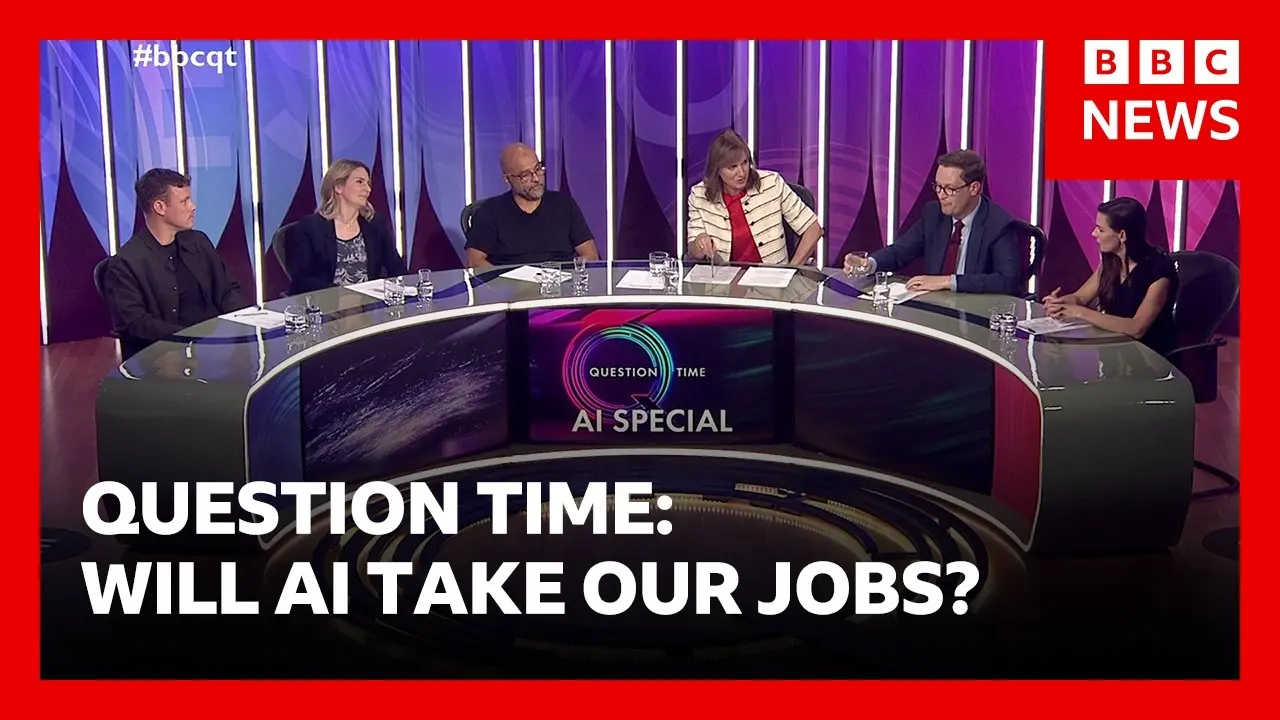
Seven in ten workers globally say they are worried AI will lead to widespread unemployment. A recent BBC panel debate in the UK put that question to a room of people with direct stakes in the answer: a tech entrepreneur, an economist, a Labour politician, a company experimenting with AI in real time, and a computer science graduate who had just applied to 150 jobs without success. They didn’t reach consensus, which is itself informative.
Two Opening Positions
The panel splits quickly. One participant, a tech entrepreneur whose company licenses actors’ likenesses for AI-generated training content, argues that displacement is real but temporary, and that new jobs will emerge as they always have. His reference point is familiar: fifty years ago, nobody could have predicted that most office work would involve staring at a screen, yet the economy absorbed it. The other main panelist predicts 20 to 30 percent unemployment in some sectors within two to three years. His argument is not that AI itself is the problem. It is that business owners will choose to cut costs rather than use AI to expand what their workers can do.
Both positions contain something defensible. The optimist’s view draws support from the historical pattern of general-purpose technologies, where short-term displacement eventually gives way to new job creation. The pessimist’s point about corporate incentives is harder to dismiss: individual firms have strong reasons to reduce headcount even when the aggregate effect damages the consumer base that supports the economy.
The Demand Side Problem
The GDP argument raised in the debate deserves more attention than it usually gets. If enough organizations simultaneously cut workers to save costs, they collectively shrink the purchasing power of the population that buys their products. Machines, as one participant puts it, spend nothing. Consumer spending accounts for roughly 70% of GDP in most advanced economies, which means mass displacement without wage replacement is not just a social problem. It is a mathematical problem for the companies doing the displacing.
This is not a new concern. Economists have debated versions of it since at least the 1930s, when John Maynard Keynes wrote about technological unemployment as a real short-term risk even while predicting long-run abundance. What is different now is the speed at which AI can move across cognitive tasks, specifically the service-sector jobs that dominate economies like the UK’s, rather than being confined to physical labor or narrow automation.
What the Graduate in the Room Represents
One of the sharper moments in the discussion comes from an audience member who graduated in computer science two weeks earlier and had already applied to more than 150 positions. His read is direct: companies are using AI to replace entry-level software engineering roles, and he expects the field to be unrecognizable in ten years.
The data supports his anxiety. Entry-level job postings in the US have declined roughly 35% since January 2023, according to labor research firm Revelio Labs. In tech specifically, fresh graduate hiring at major companies has fallen more than 50% over three years, per a SignalFire study. Only 30% of the Class of 2025 secured a full-time job in their field, down from 41% the year before, according to the Cengage Group Graduate Employability Report.
This is a global pattern, not a UK one. In Germany, Stepstone’s analysis of four million job ads from 2020 to 2025 found that entry-level positions declined significantly across sectors. Indian IT services companies have reduced junior roles by 20 to 25 percent due to automation, according to EY. The graduate’s problem is structural and cross-border.
The Ladder Problem
An audience member raises something that goes underappreciated in most coverage of AI and jobs: it is not just that entry-level roles are disappearing. It is that those roles are how workers build the competence to critique, supervise, and ultimately deploy the tools that are replacing them. If a generation skips the foundational years of doing things manually, they may lack the judgment to know when AI output is wrong.
A 2026 CNBC analysis framed the structural issue directly: losing entry points reshapes how organizations grow talent from within. The career ladders that took workers from junior roles to senior ones depended on learning through execution. Automating the bottom rung does not just affect the people on it. It changes what the ladder produces over time.
What the Actual Data Shows
A consistent theme in the debate is that prediction is unreliable, and the research supports that caution. A large-scale survey of over 5,000 senior executives across the US, UK, Germany, and Australia, conducted between November 2025 and January 2026, found that over 80% of firms reported no measurable impact from AI on either employment or productivity so far, while simultaneously predicting meaningful effects in the next three years. That gap between current experience and near-term expectation is worth sitting with.
McKinsey’s analysis found that as of end-2025, nearly nine in ten companies had deployed AI in at least one function, but 94% reported not seeing significant value from those investments. This echoes what the debate’s business owner says directly: his company is currently spending more on AI experimentation than it is saving, most attempts are failing, and genuine returns are still years away. That is not an argument against concern. It is an argument that the timeline is less certain than headlines suggest.
The Political Question
The Labour politician on the panel is candid about the bind. The UK economy is around 80% services, exactly the sector most exposed to large language models. He argues for skills investment and keeping AI-generated wealth inside the national economy rather than allowing it to flow to US tech companies. His opponent argues the government is compounding the problem by raising employment costs, adding regulatory friction, and slowing AI adoption within government itself.
Neither argument is wrong on its own terms, which is part of why the politics of this are difficult. What is clear is that the policy response needed is genuinely novel. Past technological transitions played out over decades, allowing education systems and labor markets to adjust. The current pace of AI capability development is faster, and the cognitive tasks now in scope are the ones that services-heavy economies like the UK, Germany, and Japan have built their post-industrial models around.
The Scarcity Reversal Argument
The tech entrepreneur makes one point worth holding onto. He argues that as AI makes analytical, numerical, and software-development skills cheaper to produce, the value of what has always been relatively abundant will rise: human attention, relationship, and connection. The consumer willing to pay more to speak to a person, in his framing, becomes a meaningful economic signal.
There is some directional evidence for this. Research published in April 2026 found that AI-exposed industries saw wage and job growth where AI complemented rather than replaced human tasks. But that finding sits alongside the entry-level data above, which shows concentrated harm to workers at the start of their careers, the group least able to wait out a transition period. Whether the new scarcity premium arrives fast enough to matter for the 2025 graduate is a question the optimist’s framing does not answer.