
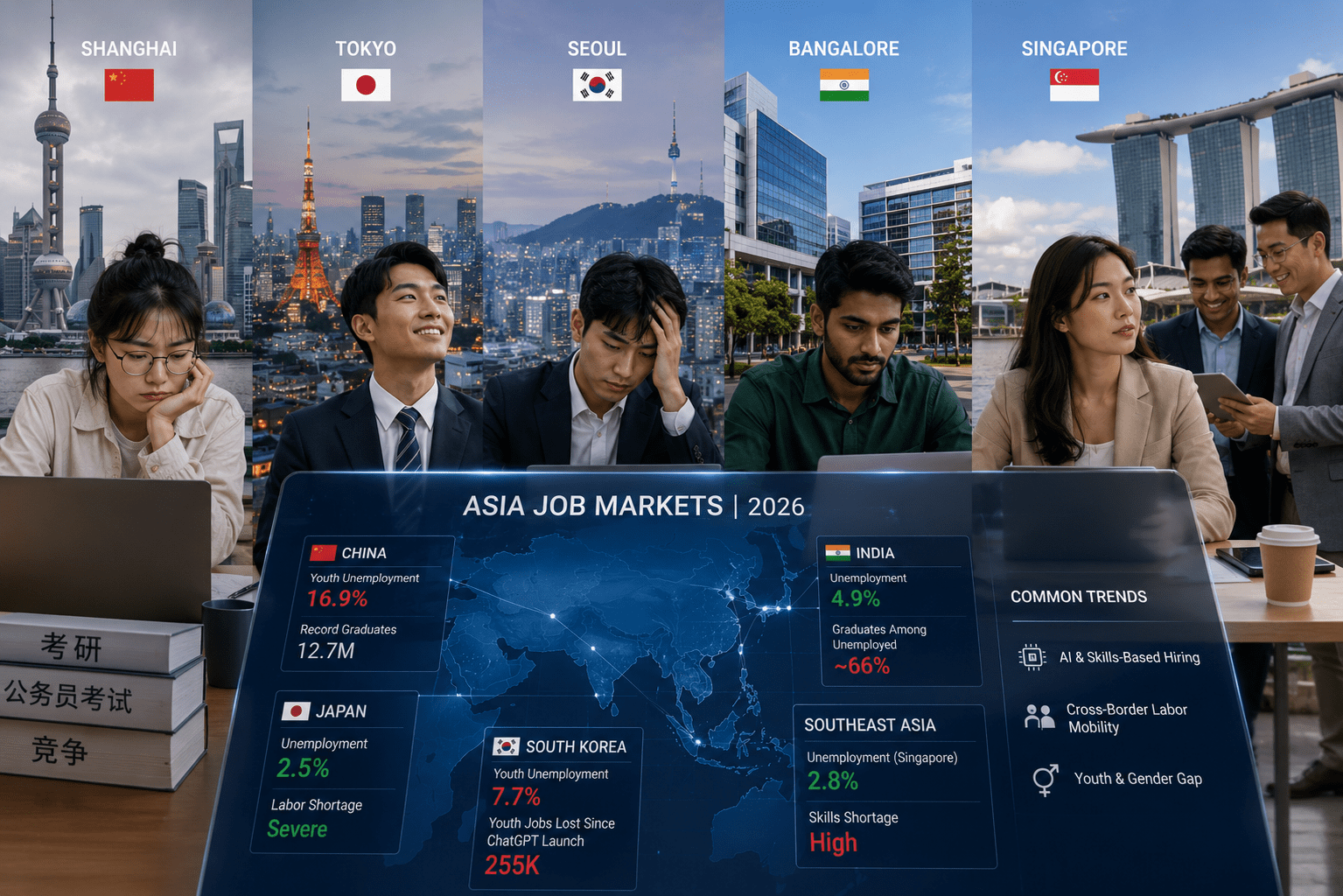
There is no single Asian job market. A new graduate in Shanghai and one in Tokyo are living through opposite problems at the same moment: one is competing against a record flood of fellow graduates for too few jobs, the other is being courted by employers who cannot find enough workers. Both realities are happening in 2026, a few thousand kilometres apart.
That contrast is the most useful thing to understand about employment across Asia right now. The headline numbers, where they exist, hide more than they reveal. But a few clear patterns separate the region’s major economies, and they matter for anyone deciding where to study, work, or look for opportunities.
China: too many graduates, not enough jobs
China’s defining employment problem is one of oversupply at the top. A record 12.7 million university students are set to graduate in 2026, about 480,000 more than the previous year, into an economy weighed down by a property slump and weak private investment.
Youth unemployment reflects the strain. The jobless rate for 16-to-24-year-olds, excluding students, stood at 16.9 percent in March 2026, having peaked at 18.9 percent in August 2025 under a methodology that no longer counts students. The figure fluctuates month to month and many analysts believe the real rate is higher.
The deeper issue is mismatch. China spent two decades pushing more young people into university, with the higher-education enrollment rate rising from 17 percent in 2003 to 60 percent by 2023. The economy did not generate enough white-collar jobs to absorb them. Many graduates are now choosing postgraduate study to delay entering the market, or competing for stable government positions known as “iron rice bowls.”
Japan: the opposite problem
Japan’s challenge is scarcity, not surplus. Unemployment sits at roughly 2.5 to 2.6 percent, which sounds like good news until you understand what it means: there are almost no idle workers left to hire.
The cause is demographic. People aged 65 and older reached a record 36.25 million in 2024, about 29.3 percent of the population, against a fertility rate near 1.2 births per woman. The working-age population has been shrinking since the mid-1990s. The Bank of Japan’s measure of employment conditions recently hit its most acute labor shortage in three decades.
The effects ripple outward in ways that favor workers. Japan’s tech sector alone faces a projected shortfall of 220,000 IT professionals in 2026. Companies long known for hiring on loyalty and lifetime employment are shifting toward skills-based hiring, opening doors for career changers and foreign workers. The number of foreign workers reached a record 2.3 million, a structural change for a country historically resistant to immigration.
South Korea: low unemployment, a youth recession
South Korea shares Japan’s demographic outlook but not its labor market. Overall unemployment is low, at 2.9 percent in February 2026, yet young people are living through something the headline number hides entirely. Youth unemployment for those aged 15 to 29 rose to 7.7 percent in February 2026, and the youth employment rate has fallen for more than 40 consecutive months, a decline that began in late 2022.
The cause is structural, not cyclical. Korean employers have shifted decisively toward experience-oriented hiring, favoring proven mid-career candidates over entry-level graduates who need training. Entry routes that once absorbed young workers have all eroded at once: manufacturing employment has fallen for around 21 straight months, construction for 23. A Bank of Korea report found that 255,000 youth jobs disappeared in the four years after ChatGPT launched, as AI changed hiring in ways that hit younger workers hardest.
The result is a phenomenon that has acquired its own vocabulary: a “resting” generation of young people who have stopped actively searching. The government has leaned on the country’s largest conglomerates to respond, with Samsung, SK, and Hyundai announcing hiring drives to boost youth employment. Whether corporate hiring pledges can offset a structural shift away from entry-level training remains the open question.
India: stable on the surface, fractured underneath
India’s overall unemployment rate looks reassuring at around 4.9 percent in early 2026. The number underneath it is the one that matters. Graduates make up roughly two-thirds of India’s unemployed, and the World Bank reports that youth account for about 72 percent of the jobless.
This is a skills-mismatch story more than a jobs-shortage story. India is producing graduates faster than its education system is producing employable ones, though that gap is narrowing. The India Skills Report 2026 put overall employability at 56.35 percent, up from 54.81 percent the previous year. Computer science and IT graduates fare best, while degrees from industrial training institutes lag well behind. Demand is concentrated in metros and specific sectors: technology, banking, healthcare, and increasingly AI, where India already commands a meaningful share of the global talent pool.
Southeast Asia: tight markets and a scramble for skills
Southeast Asia largely escaped the youth-unemployment crisis seen in China, but faces its own version of a skills shortage. Singapore held unemployment around 2.8 percent through 2025, and across the region demand for skilled workers outpaced supply, especially in semiconductors, digital manufacturing, and tech.
The contrast within the region is sharp. Indonesia recorded the highest unemployment rate in Southeast Asia at 4.74 percent in February 2026, while neighboring economies sat near full employment. Companies across Singapore, Malaysia, the Philippines, and Vietnam are moving toward skills-based hiring and multi-country recruitment to fill gaps the local talent pool cannot.
The common threads
Beneath the divergence, three forces are acting on nearly every Asian labor market at once.
The first is AI and the shift to skills-based hiring. From Tokyo to Bangalore, employers are de-emphasizing credentials and prioritizing demonstrable skills in AI, data analytics, cybersecurity, and cloud computing. The degree as automatic passport to a good job is weakening everywhere, fastest in the markets with the most graduates.
The second is a growing reliance on cross-border labor. Japan imports workers to survive demographically. Southeast Asian firms recruit across borders to fill skills gaps. Tariff-driven supply-chain shifts are moving manufacturing toward Vietnam, India, and Bangladesh, redistributing factory work across the region.
The third is a youth employment gap that, even in tight markets, falls hardest on young women. The ILO reports that across Asia and the Pacific, youth unemployment runs around 20 percent, but reaches 30.4 percent for young women against 11.3 percent for young men. That gap persists across economies with otherwise opposite conditions.
For job seekers, the practical takeaway is that “moving to Asia for work” means almost nothing without specifying where. A mid-career software professional has very different prospects in labor-starved Japan than a fresh graduate in graduate-saturated China. The skills in demand are converging across the region. The conditions under which you compete for them are not.