
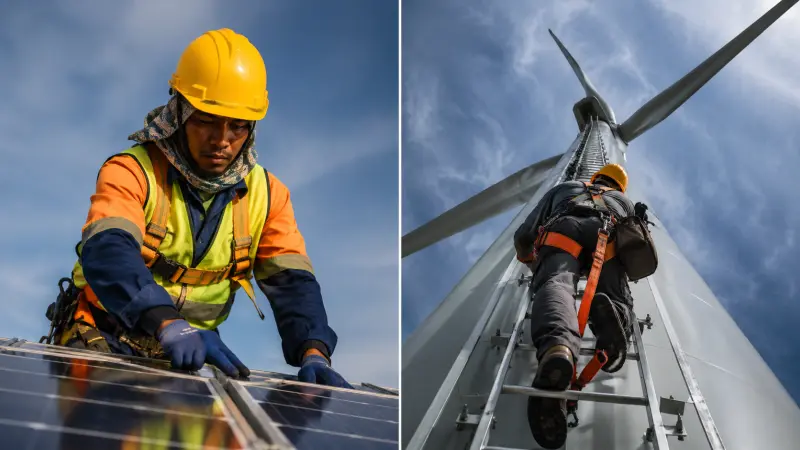
Most people picture the green economy as a place for engineers and environmental scientists. That assumption is wrong, and it is costing people who could be working in it.
According to the IRENA-ILO Renewable Energy and Jobs Annual Review published in January 2026, global renewable energy employment reached 16.6 million jobs in 2024. The majority of those jobs are in installation, maintenance, and manufacturing — trades, not laboratories. In many markets, the sector cannot hire fast enough.
Solar panels are going up faster than trained technicians can install them. Wind farms are being commissioned in regions where qualified maintenance engineers are scarce. A May 2026 study in Phys.org identified renewable energy and construction as the sectors with the most acute and complex skills shortages globally. That gap is an opening.
Where the jobs are
Solar photovoltaic (PV) is the dominant employer by a wide margin, accounting for 7.3 million jobs worldwide in 2024. Wind energy employs 1.9 million, hydropower 2.3 million, and liquid biofuels 2.6 million, according to IRENA data.
The geographic distribution matters. China accounts for 44% of all renewable energy employment globally — 7.3 million jobs — driven by both manufacturing and domestic installation. The EU employs 1.8 million people across the sector. Brazil has 1.4 million renewable energy workers, powered largely by biofuels and wind. India has 1.3 million and is growing faster than the headline figure suggests.
The United States sits at 1.1 million, where the Bureau of Labor Statistics projects solar PV installer employment to grow 48% through 2033 and wind turbine technician employment to grow 60% over the same period — making both among the fastest-growing occupations in the country.
Outside these major markets, green employment is expanding across Southeast Asia, West Africa, and parts of Latin America, driven by international climate finance and rapid cost declines in solar hardware.
What qualifications most roles actually require
The hands-on roles that make up the bulk of green employment — solar PV installer, wind turbine technician assistant, energy auditor, green energy sales representative — do not require university degrees.
March 2026 job listing data shows that 90% of entry-level renewable energy postings list the OSHA-10 safety card as the primary credential requirement. That certification takes 10 hours to complete and costs under $100 in most markets, though equivalent safety credentials exist in most countries under different names.
Beyond safety certification, what employers consistently flag as essential: electrical fundamentals (understanding circuits, wiring, and system diagrams), familiarity with energy monitoring software and SCADA systems in field roles, and the ability to work in physically demanding or remote environments. Soft skills — safety awareness, teamwork, clear communication — come up in nearly every employer account of what separates hires from rejections.
Advanced or specialized roles do require more. Solar energy systems engineers typically need a relevant bachelor’s degree. Wind turbine service technicians in many markets require a post-secondary certificate in wind energy technology, covering electrical, hydraulic, and mechanical systems. Grid modernization and energy storage roles increasingly require experience with battery management systems and smart grid protocols.
The career structure tends to follow a clear ladder: entry-level installation or maintenance work, then systems technician, then site supervisor or project coordinator. Moving up the ladder is substantially easier if you have completed a vocational program or industry certificate alongside field experience.
The skills gap is an advantage for new entrants
Renewable energy is one of the few sectors where the demand for workers is genuinely outpacing supply in multiple regions simultaneously. The Renewable Energy Institute notes that employers in several markets are now factoring in on-the-job electrical training as a first step — meaning some employers are hiring people without full credentials and training them. That is unusual in most job markets right now.
There is also a documented overlap emerging between green skills and AI or data skills. Sustainability Magazine reported in 2026 that green talent is rapidly acquiring AI skills, and roles that combine both command significantly higher salaries. This is still early-stage enough that a job seeker who develops both in parallel can position well ahead of the curve.
Where to actually find these jobs
General job boards carry some renewable energy listings, but specialist boards tend to have better volume and signal-to-noise ratio:
Rejobs.org is the most globally focused dedicated renewable energy job board, covering solar, wind, grid, storage, and more across multiple countries and languages. It also has a section specifically for students and early-career candidates.
GetIntoEnergy.org operates primarily in North America but carries a useful careers database and includes apprenticeship and training program listings — useful for understanding what entry-level pathways look like structurally.
ClimateJobTraining.com bridges the gap between training resources and job listings, aimed specifically at people who are retraining or entering the sector for the first time.
For manufacturing roles in solar and wind, the large general boards — LinkedIn, Indeed, and their regional equivalents — carry significant volume in China, India, and Southeast Asia. In those markets, Naukri (India), Jobstreet (Southeast Asia), and LinkedIn remain the most reliable first stop.
A note on where the growth is uneven
The 16.6 million figure represents a 2.3% growth rate — the slowest in several years. The IRENA report attributes this partly to China’s solar manufacturing sector cutting 87,000 jobs in 2024 despite record installations, as automation and consolidation reduce headcount per unit of output. Manufacturing jobs in solar, particularly in China, are under pressure even as installation jobs elsewhere grow.
The practical implication for job seekers: installation, maintenance, and field roles are more stable bets than manufacturing roles. And geography matters — markets with strong domestic clean energy policy (EU, India, Brazil, parts of Southeast Asia) are adding field jobs faster than markets where policy is uncertain.