Level: C1 • Topic: Career Development / Educational Technology
Part 1: The Emergence and Prevalence of AI Interviews
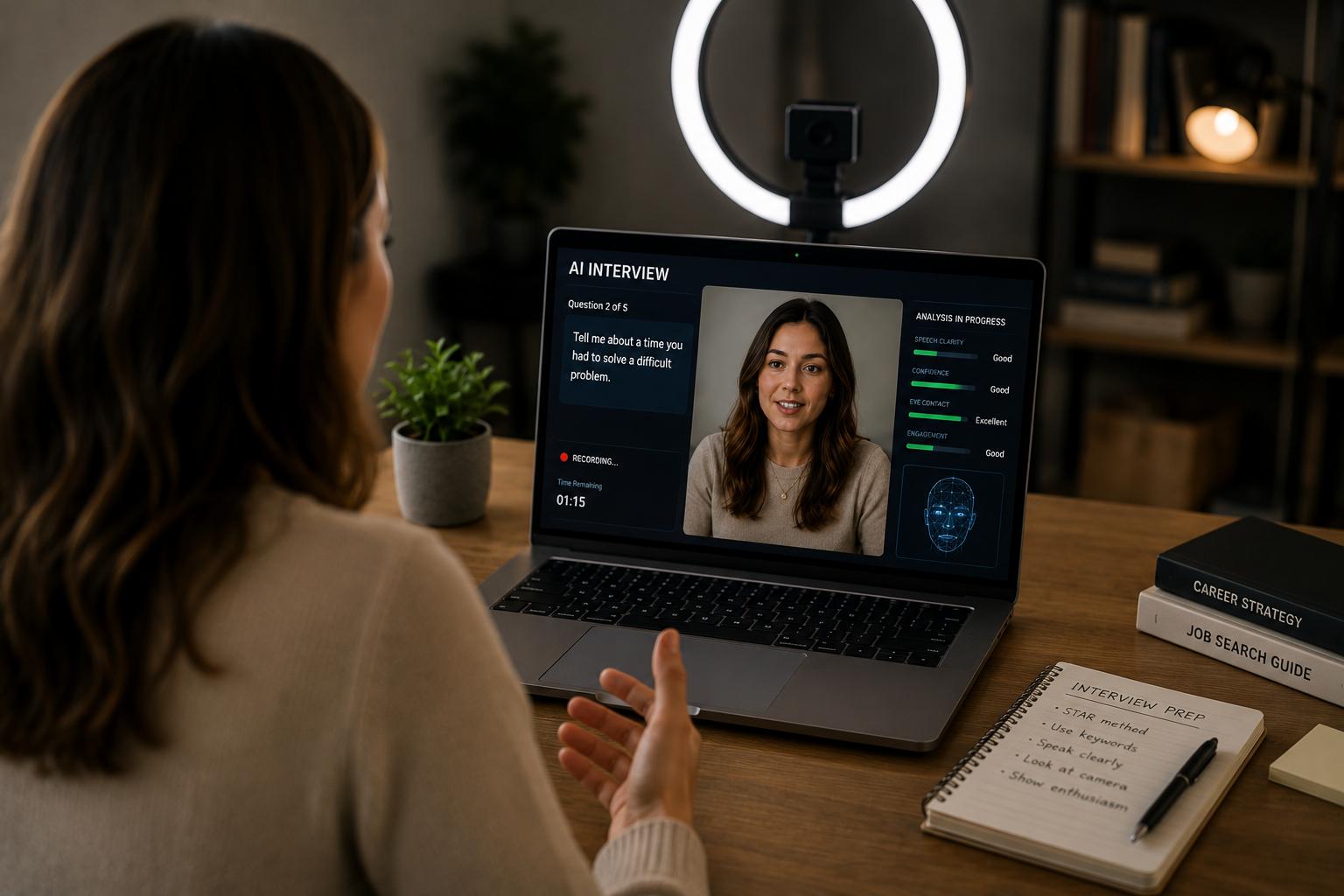
The traditional “face-to-face” meeting is rapidly being superseded by the Asynchronous Video Interview (AVI), commonly referred to as the AI interview. In this paradigm, candidates do not interact with a human recruiter; instead, they respond to prompts on a screen while being recorded. As of 2026, the adoption of these platforms has seen an exponential surge. Recent industry data suggests that approximately 45% of Fortune 500 companies now utilize some form of AI screening for entry-level and mid-level positions.
The primary driver behind this shift is fiscal and operational efficiency. By automating the initial screening phase, companies can process thousands of applicants in the time it once took to interview dozens. Statistics from 2025 indicated that AI screening reduced the “time-to-hire” metric by nearly 60% in the tech and finance sectors. Furthermore, proponents argue that AI can mitigate human unconscious bias, though this remains a point of significant contention among sociologists.
In the current job market, particularly in highly competitive hubs, encountering an AI bot like HireVue or Paradox is no longer a fringe occurrence; it is the standard “gatekeeper.” For university graduates, this means that the first hurdle to employment is not proving their skills to a person, but rather optimizing their performance for an algorithm. This shift requires a recalibration of traditional interview prep, moving away from interpersonal “chemistry” toward technical and linguistic precision.
Part 2: The Digital Scrutiny: What is Being Assessed?
When you sit before an AI interviewer, the software is performing a multi-layered analysis that far exceeds the cognitive capacity of a human recruiter. This assessment generally falls into three categories: Natural Language Processing (NLP), Sentiment Analysis, and Prosody.
NLP examines your vocabulary and semantic density. The algorithm cross-references your spoken words with a “success profile” provided by the employer, looking for specific keywords and industry-specific jargon. If your responses lack the requisite terminology, the AI may flag you as unqualified, regardless of your actual experience.
Beyond what you say, the AI evaluates how you say it. Sentiment analysis tools track facial muscle movements—often using the Facial Action Coding System (FACS)—to detect micro-expressions that indicate confidence, hesitation, or dishonesty. Simultaneously, the system analyzes your vocal inflection and “prosody” (the rhythm and pitch of your speech). A voice that is too monotone may be interpreted as a lack of engagement, while excessive filler words (like “um” or “uh”) are quantified as markers of low fluency. Finally, the AI tracks eye-line persistence to ensure you are looking at the camera, which is algorithmically equated to maintaining eye contact in a physical setting.
Part 3: Strategic Preparation for Algorithmic Success
Performing well in an AI interview requires a blend of theatricality and technical intentionality. First, you must address the “environmentals.” Unlike a human, an AI cannot “adjust” for poor lighting or background noise; it simply receives a degraded data signal. Ensure you have three-point lighting to eliminate shadows that might be construed by the AI as negative facial expressions.
Second, your delivery must be optimized for machine “listening.” This involves a deliberate use of the STAR method (Situation, Task, Action, Result), but with a heightened focus on keywords. Because the AI is looking for congruence between your resume and your speech, you should use the exact terminology found in the job description. Speaking slightly slower than usual can also improve the AI’s transcription accuracy, ensuring your points land cleanly.
Finally, “perform” for the lens, not the screen. Looking at the interviewer’s face on the screen creates the appearance of looking down. Direct eye contact with the camera lens is paramount for a high “engagement score.” While it may feel inherently unnatural to smile at a plastic lens, the software is programmed to reward “positive affect.” Treat the session as a professional broadcast rather than a conversation. By mastering these nuances, you can move through the digital “black box” and secure the human-led interview that follows.
Vocabulary List
- Paradigm: (패러다임/전형적인 방식) A typical example or pattern of something.
- Surge: (급증) A sudden powerful forward or upward movement.
- Fiscal: (재정의) Relating to government revenue or general financial matters.
- Mitigate: (완화하다) To make something less severe, serious, or painful.
- Contention: (논쟁) Heated disagreement or an assertion maintained in an argument.
- Fringe: (비주류의) Not part of the main, conventional, or dominant group.
- Recalibration: (재조정) The act of adjusting something again or differently.
- Precision: (정밀함) The quality, condition, or fact of being exact and accurate.
- Cognitive: (인지적인) Relating to the mental action or process of acquiring knowledge.
- Semantic: (의미론적인) Relating to meaning in language or logic.
- Jargon: (특수 용어) Special words or expressions used by a particular profession.
- Requisite: (필요조건) Made necessary by particular circumstances or regulations.
- Sentiment analysis: (감성 분석) The use of AI to identify emotional tone in text or speech.
- Inflection: (억양) A change in the form of a word or pitch of a voice.
- Monotone: (단조로운) A continuing sound that is unchanging in pitch.
- Fluency: (유창함) The ability to speak or write a language easily and accurately.
- Algorithmically: (알고리즘적으로) In a manner following a fixed set of rules or processes.
- Intentionality: (의도성) The fact of being deliberate or purposive.
- Construed: (해석되다) Interpreted in a particular way.
- Deliberate: (의도적인) Done consciously and intentionally.
- Congruence: (일치) Agreement or harmony; consistency.
- Paramount: (가장 중요한) More important than anything else; supreme.
- Inherently: (본질적으로) In a permanent, essential, or characteristic way.
- Nuance: (미묘한 차이) A subtle difference in meaning, expression, or sound.
- Prosody: (운율/말의 가락) The patterns of stress and intonation in a language.
20 Common AI Interview Questions
- Tell me about a time you handled a difficult conflict with a coworker.
- What is your greatest professional achievement to date?
- How do you handle tight deadlines and high-pressure situations?
- Describe a situation where you had to learn a new technology quickly.
- Why are you interested in working for this specific organization?
- Give an example of a time you showed leadership skills.
- How do you prioritize tasks when you have multiple competing projects?
- Describe a time you failed. What did you learn from the experience?
- What would your previous supervisor say is your biggest area for improvement?
- How do you ensure accuracy and attention to detail in your work?
- Tell me about a time you had to persuade someone to see your point of view.
- Where do you see yourself professionally in five years?
- How do you handle receiving critical feedback?
- Describe a time you went above and beyond for a client or customer.
- What motivates you to stay productive during repetitive tasks?
- How do you handle ambiguity or a lack of clear instructions?
- Describe your ideal work environment.
- Tell me about a time you had to work with someone whose personality was very different from yours.
- What specific skills do you possess that make you the best fit for this role?
- Imagine a colleague is acting unethically. How would you respond?
Discussion Questions
- Do you believe an AI can accurately judge a person’s character? Why or why not?
- Is it ethical for companies to use “sentiment analysis” to track a candidate’s facial expressions?
- Some argue AI interviews reduce bias, while others say they encode it. Which side is more convincing?
- How does the lack of a “human” presence change the way you feel during an interview?
- Do you think “eye-line persistence” is a fair marker for professional engagement?
- How might an introvert and an extrovert perform differently in an AVI setting?
- Should candidates be allowed to see their “AI score” after an interview?
- Will the traditional face-to-face interview eventually become obsolete?
- How can a candidate show “personality” when they are speaking to a recording?
- If you were a recruiter, would you trust an algorithm’s “Top 10” list of candidates?
Simulated AI interview prompt:
English Voice Prompt
“Please act as a professional AI recruiter for a [Job Title] position. I want to do a mock interview where you ask me five behavioral questions one by one. Please wait for my response after each question without giving any feedback or corrections during the interview. After the fifth question is finished, let me know the interview is over and then provide a detailed evaluation of my grammar, my use of the STAR method in my answers, and my overall speaking confidence. Finally, please give me three specific tips to help me improve. Go ahead and introduce yourself and ask the first question now.”
Korean Voice Prompt (한국어 음성 프롬프트)
“안녕하세요, [희망 직무] 포지션의 전문 면접관 역할을 맡아주세요. 저와 함께 5개의 행동 기반 질문으로 가상 면접을 진행하고 싶습니다. 질문은 하나씩 해주시고, 제가 답변할 때까지 기다려 주세요. 면접 중에는 피드백이나 수정을 하지 마시고, 5번째 답변이 모두 끝난 후에 제 문법과 어휘, STAR 기법 활용도, 그리고 말하기 자신감에 대해 상세히 평가해 주세요. 마지막으로 실전 면접을 위한 구체적인 팁 3가지도 함께 제안해 주세요. 이제 자기소개와 함께 첫 번째 질문을 시작해 주세요.”
Recommended Online Resources
- How to Ace an AI Interview — Harvard Business Review
- A comprehensive guide on optimizing your physical and linguistic delivery for automated systems.
- The Ethics of AI in Hiring — TEDx Talk by Dr. Joan Smith
- A critical look at algorithmic bias and the social implications of automated recruitment.
- Understanding HireVue and Asynchronous Interviews — CareerCenter Blog
- A practical breakdown of the most common platforms and technical requirements for students.
- Natural Language Processing in Recruitment — YouTube Tech Explainer
- A visual explanation of how NLP software “listens” for keywords and semantic density.