Nearly every conversation about work over the past two years has carried the same undercurrent: will AI take my job? The honest answer is that some jobs will disappear, and some already are. But the more useful question is which ones, and why — because the pattern is more specific than most headlines suggest.
The World Economic Forum’s Future of Jobs Report 2025 projects that 92 million roles will be displaced by 2030, while 170 million new ones emerge — a net gain on paper, though that math offers cold comfort if you’re in one of the disappearing categories. McKinsey estimates that today’s AI tools could theoretically automate around 57% of current U.S. work hours. Not 57% of jobs eliminated — 57% of hours, spread across almost every occupation.
That distinction matters. AI is restructuring work faster than it’s eliminating it. And the jobs with the most structural protection share a few common traits.
The trades are having an unexpected moment
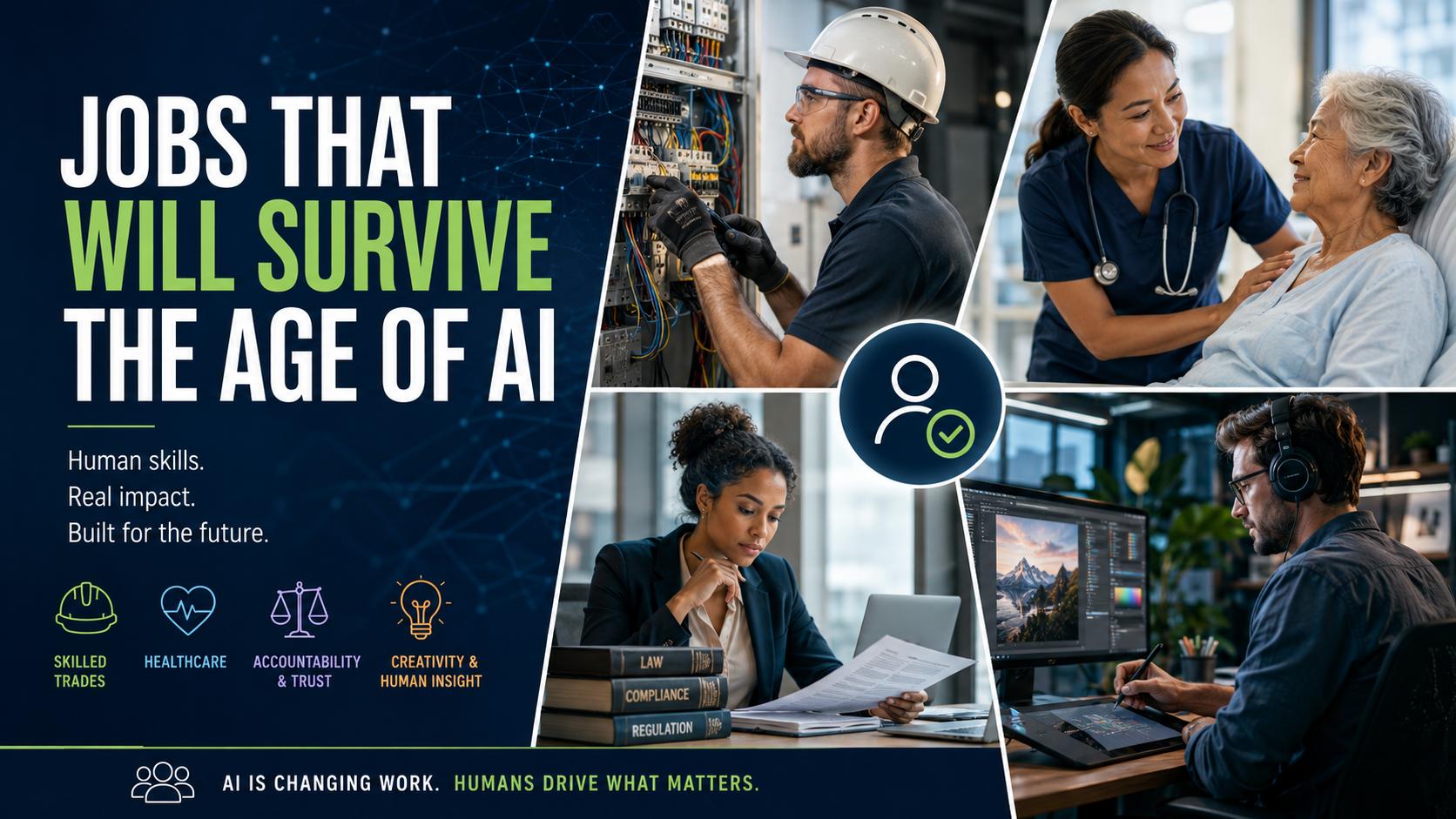
Here is something the AI anxiety conversation mostly ignores: electricians, plumbers, HVAC technicians, and carpenters are currently some of the most in-demand workers in the world — and AI is part of the reason why.
Building the data centers that power AI requires enormous amounts of physical infrastructure. Nvidia CEO Jensen Huang said publicly in 2025 that the U.S. will need “hundreds of thousands” of electricians and plumbers just to build the factories and facilities the AI boom demands. BlackRock CEO Larry Fink told the White House the same thing more bluntly: “We just don’t have enough.”
The numbers support the urgency. According to a 2026 report from JLL, by 2030 an estimated 2.1 million skilled trades positions could go unfilled in the U.S. alone, with potential economic losses reaching $1 trillion annually. Electrician positions are projected to grow 9.5% through 2034 — more than triple the 3.1% average across all occupations, per the same report. The U.S. is expected to be 550,000 short of plumbers by 2027, according to Bloomberg.
None of this is happening because trades are easy. It’s happening because they’re hard to automate. Repairing a leaking pipe in a crowded apartment building, diagnosing why an old building’s wiring is behaving strangely, or installing HVAC systems across varied real-world environments — these jobs involve physical problem-solving in unpredictable conditions that current robotics cannot handle cost-effectively.
The irony is sharp: the AI boom may be the best thing that has happened to trade careers in a generation.
Healthcare isn’t going anywhere
Healthcare is the other sector with strong structural protection, for different reasons.
AI is genuinely useful in medicine — diagnostic imaging, documentation, drug discovery, scheduling. But patients still want a human making consequential decisions about their bodies. That preference is not irrational. Trust, physical presence, and emotional attunement are part of what healthcare actually delivers, not just the technical output.
Registered nurses, physical therapists, mental health professionals, and eldercare workers all operate in environments where the relational dimension of the work is inseparable from the clinical dimension. AI can assist with documentation and flag anomalies in test results. It cannot hold someone’s hand during a difficult diagnosis or physically support a patient through rehabilitation.
Globally, this matters even more. Aging populations across Japan, South Korea, Germany, and much of Southern Europe are creating sustained demand for healthcare workers that demographic trends are likely to sustain for decades.
Accountability is its own protection
One underappreciated category of resilience is work tied to legal, financial, or ethical responsibility.
AI can draft a contract in seconds. It cannot absorb liability when something goes wrong. That distinction keeps lawyers, auditors, compliance officers, and senior managers in place across heavily regulated sectors — banking, healthcare, aviation, pharmaceuticals, government — even as AI handles growing portions of the underlying workflow.
Cybersecurity sits in a similar position. AI creates new attack surfaces at roughly the same rate it creates efficiencies. The demand for people who can identify vulnerabilities, interpret ambiguous threats, and respond under pressure is growing rather than shrinking, in part because AI tools are expanding the scope of what needs defending.
Creative work survives, but the middle hollows out
AI image generators and writing tools have already automated large categories of basic design, copywriting, and content production. Entry-level creative roles are under real pressure, and that pressure is not temporary.
But creative industries do not disappear. They reorganize around originality and audience trust.
People still pay for musicians despite free streaming. They still follow specific journalists despite infinite online content. What erodes is the middle layer of routine creative output — the work that was always competent but rarely distinctive.
What survives, and potentially grows more valuable, is the ability to combine storytelling, strategy, and audience understanding with genuine point of view. A designer who understands creative direction, distribution, and brand thinking may outperform a technically stronger competitor who relies only on craft. A writer with a specific, trusted voice is harder to replace than one producing interchangeable content.
The real danger zone
The jobs under greatest pressure share a clear profile: highly repetitive, entirely computer-based, and easy to measure with clear outputs.
Data entry, transcription, basic customer support, scheduling, and routine administrative work are the obvious targets. But the pressure extends into knowledge work. Junior analysts, paralegals, marketing coordinators, and entry-level recruiters increasingly compete with AI systems that produce competent first drafts in seconds.
The Yale University labor market analysis found something worth noting: AI appears to be suppressing hiring more than destroying existing jobs in the near term. Companies are integrating AI to avoid adding headcount rather than immediately firing existing workers. For people trying to enter the workforce, the downstream effect — fewer entry-level positions to build career capital from — may be as serious as direct displacement.
Working with AI is becoming the skill
The workers most likely to do well over the next decade are not necessarily those with the highest credentials. They are the ones who adapt as tools change — and who learn to use AI as leverage rather than treat it as a threat.
A nurse using AI to manage documentation handles more patients. A lawyer using AI for research takes on larger caseloads. A teacher using AI to personalize lesson plans reaches students more effectively. In each case, AI raises the output ceiling without replacing the human judgment at the center of the work.
Calculators did not eliminate accountants. Spreadsheet software did not eliminate finance professionals. Both changed what was expected of them. AI is likely to do the same across hundreds of occupations — and the workers who adapt earliest tend to benefit most from that shift.
The jobs with staying power are not necessarily the most technical. They are the ones where the human element — care, judgment, physical adaptability, accountability, trust — is genuinely hard to replicate at scale. That list is longer than the current anxiety suggests.