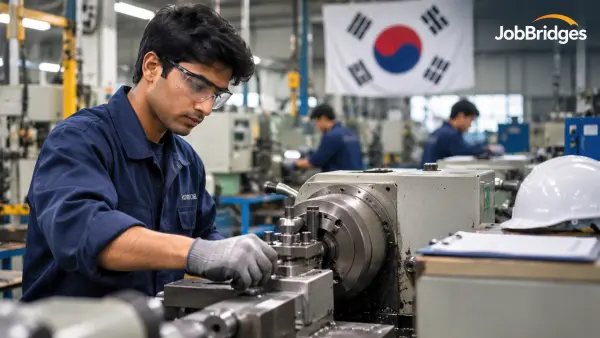
South Korea’s Employment Permit System, which issues the E-9 visa, is the country’s main legal route for workers without a degree. It recruits only through government agencies in 17 partner countries, with Kazakhstan due to become the 18th, and it fills jobs in small factories, farms, fishing boats, building sites and a few service trades. Candidates pass a Korean-language test and a skills test at home, wait on a roster until an employer picks them, and then work on a contract of up to three years that can be extended to four years and ten months.
The intake has swung sharply. The government set a ceiling of 165,000 new E-9 workers for 2024, 130,000 for 2025 and 80,000 for 2026. The ceiling has not been the binding limit, though: by the end of November 2025, only 48,668 permits had been issued against that year’s 130,000. This guide covers who can apply, how selection works, what the jobs pay, where the system fails workers, and the reform the government promised in April 2026 and has not yet published.
Eighteen countries, all through government agencies
When Korea’s Foreign Workforce Policy Committee added Kazakhstan as a sending country on 14 August 2026, it joined the Philippines, Mongolia, Sri Lanka, Vietnam, Thailand, Indonesia, Uzbekistan, Pakistan, Cambodia, China, Bangladesh, Kyrgyzstan, Timor-Leste, Nepal, Myanmar, Laos and Tajikistan. Kazakh workers are not expected to arrive before 2028, once a government-to-government agreement and a local test center are in place. Citizens of any other country cannot use the route.
Each country runs registration through one public body, such as the Sri Lanka Bureau of Foreign Employment or the Philippines’ Department of Migrant Workers, working with Korea’s Human Resources Development Service (HRD Korea). A recent Sri Lankan test notice sets the basic conditions found across the scheme: applicants must be 18 to 39, have no criminal record of imprisonment or heavier punishment, and have no history of deportation or forced departure from Korea. The test fee in that round was USD 28.
From test to workplace, in nine steps
Korea’s public employment portal, Work24, and the sending-agency notices set out the sequence:
- The candidate registers with their country’s sending agency during an announced round and sits the EPS-TOPIK, a 50-minute computer-based Korean test of 40 reading and listening questions.
- Candidates above each industry’s minimum score are ranked, and the top scorers, up to 1.1 times the round’s planned intake, go on to a second-round skills test: physical fitness, an interview and basic job skills. Scoring below 60% of the skills test total means failing.
- Final scores combine both rounds, with extra points for work experience, training, education and qualifications. Successful candidates who pass a health check join a jobseeker roster, valid for two years.
- A Korean employer advertises the job to Korean workers for at least seven days through Work24.
- If no Korean is hired, the local labor office recommends about three roster candidates per vacancy, the employer picks one and receives an employment permit.
- Employer and worker sign a standard labor contract, handled by HRD Korea.
- The employer applies to the Ministry of Justice for a visa issuance certificate, and the worker collects the E-9 visa from the Korean embassy.
- The worker completes pre-departure training at home and travels to Korea.
- After arrival, the worker has a health check and at least 16 hours of employment training before starting work.
The Sri Lankan notice states plainly that a place on the roster does not guarantee a job. A candidate who is never selected within the two years has to test again.
Where E-9 workers end up, and the pay floor
Labor ministry figures given to a National Assembly member put the number of workers in the system at a record 287,424 in July 2026, up from 159,463 in 2021. Manufacturing held 229,844 of them, or 80%. Agriculture and livestock had 11.8%, fisheries 5.4%, construction 2.3% and services 0.5%. The 2026 ceiling follows the same shape: 50,000 places for manufacturing, 10,000 for agriculture and livestock, 7,000 for fisheries, 2,000 for construction, 1,000 for services, and 10,000 that can go to any sector.
E-9 workers are covered by the national minimum wage, which is 10,320 won an hour in 2026. The Minimum Wage Commission set the 2027 rate at 10,700 won, up 3.7%, or 2,236,300 won a month on a 209-hour basis.
Employers outside the Seoul capital region get more workers. In its December 2025 decision, the government raised the extra hiring allowance for non-capital-region manufacturers from 20% to 30% above the capital-region limit, so a candidate selected in 2026 is more likely to be placed in a provincial industrial town than near Seoul.
The ceiling is not the number that decides your chances
The same December 2025 release describes the annual quota as a ceiling that lets employers hire as demand arises, not a target the government aims to fill. The gap is large: 48,668 permits issued by late November 2025, against 130,000 allowed. Lower quotas and a slower economy have cut employer applications, the Korea Times reported.
What decides an individual’s odds is the planned intake for each round in each country, which HRD Korea and the sending agency announce separately, and how many employers actually request workers from the roster. A high test score improves a candidate’s position, but in a year of weak factory demand many qualified people sit on the roster until it expires.
Tied to one employer: the workplace-change rules
The feature critics focus on is mobility. E-9 workers may change workplaces only for listed reasons, such as an employer ending the contract without just cause, a business closing, or a breach of contract terms, and changes are capped at three in the first three years and two during the extension. Since recent rule changes, moves must also stay within set regions and sectors, to keep workers from concentrating around Seoul.
Demand for help with those rules has climbed. Data from HRD Korea released by a lawmaker’s office and reported by Newsis show workplace-change counseling cases at foreign worker support centers rising from 44,862 in 2022 to 122,670 in 2024 and 119,022 in 2025, with 55,876 in the first half of 2026. Labor groups argue the limits leave workers exposed to abuse and want them able to move from the start. Employer groups warn that easier moves would worsen shortages and remove the incentive to train workers.
Workers who complete four years and ten months must leave Korea. Under current rules, eligible workers can leave for one month and return for a second term, for a maximum of nine years and eight months in total. Workers with four or more years can also try to switch to the E-7-4 skilled worker visa, which has its own salary, Korean-language and points requirements and allows a longer stay.
A reform announced in April, still not published
On 30 April 2026, the government set out the direction of a reform. It would let workers who meet set conditions keep working past four years and ten months without leaving, loosen the grounds, number and regional limits for workplace changes, add incentives for long service, require employers to complete human rights training before hiring, and bar employers found guilty of abuse or serious accidents from hiring foreign workers for up to three years. A full roadmap was promised for June, followed by amendments to the Foreign Workers Employment Act.
The June date passed. A ministry task force had proposed cutting the period during which job changes are capped from three years to eighteen months, against employers’ preferred two years, while keeping the regional and sector limits, Newsis reported in July. As of mid-November 2026, JobBridges could not find a published roadmap or a bill. A separate decision from August does take effect: from March 2027, hiring bans for labor-law violations will apply to an employer as a whole rather than to a single site.
Korea’s system shares features with Japan’s, which JobBridges covered in its guide to Japan’s 2027 foreign worker routes, including language tests and limits on changing employers. That guide sets out Japan’s caps and tests in detail. The Gulf offers a sharper contrast, set out in working in the Gulf after kafala.
The December quota decision
The Foreign Workforce Policy Committee usually fixes the next year’s E-9 ceiling in late December; the 2026 figure was set on 22 December 2025. The 2027 decision will show whether the government cuts again after issuing far fewer permits than it allowed, and whether it moves on the long-delayed reform.
Two dates are already fixed. From 1 January 2027, E-9 workers are owed at least 10,700 won an hour, and Kazakhstan’s first workers are expected in 2028.
Related Links
- Korea.net: Non-professional foreign worker quota for 2026 set at 191,000
- Korea JoongAng Daily: Kazakh workers to arrive in Korea by 2028
- Trend: Kazakhstan gains access to South Korea’s employment permit system
- Herald Economy: Foreign worker workplace deaths and the delayed roadmap (Korean)
- Kyunghyang Shinmun: Migrant workers demand freedom to change jobs (Korean)